EN
EN



Building or retrofitting a facility in a hot climate — whether that's the Middle East, Southeast Asia, Sub-Saharan Africa, or the southern United States — puts your building envelope under a very different kind of stress than a temperate climate project. Ambient temperatures regularly pushing 40–50°C (104–122°F), intense solar radiation, and high humidity in coastal regions mean that choosing the wrong sandwich panel can result in uncomfortable interiors, sky-high cooling bills, accelerated material degradation, and in some cases, serious fire safety risks.
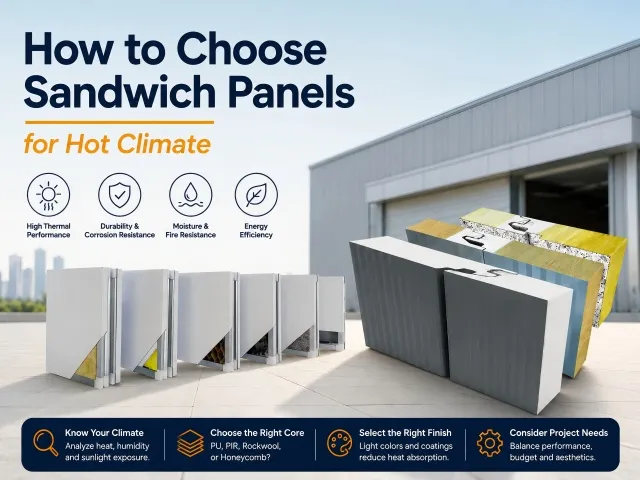
This guide walks through exactly what to look at when specifying sandwich panels for hot-climate buildings: which core materials perform well, how to read thermal performance numbers, what surface finishes hold up under UV exposure, and how to avoid the most common mistakes buyers make when sourcing panels for warm-weather projects.
1. Why Hot Climate Changes Everything
In a cold-climate country, the primary job of an insulated panel is to keep heat in. In a hot climate, the challenge is the opposite — but the thermal physics are actually more demanding. A wall or roof panel in a desert environment may face an exterior surface temperature of 70°C or higher on a summer afternoon, while the interior is expected to stay at 22°C for occupant comfort or 15°C for pharmaceutical cold chain storage. That's a 50°C delta across a single panel — sustained for hours, day after day, for decades.
Three factors combine to make hot-climate panel specification uniquely challenging:
- Solar radiation load: Direct sun adds a radiant heat gain on top of the ambient air temperature. A dark-colored roof panel facing direct sun in Saudi Arabia can reach 80°C surface temperature even when the air is only 45°C. This drives thermal bridging and accelerates coating degradation.
- Sustained temperature differentials: Unlike temperate climates where the day-night temperature swing helps buildings "reset," many hot-climate regions have warm nights too — meaning the building envelope never gets a chance to cool down, and the cumulative heat load is far higher than peak temperature alone suggests.
- UV intensity: UV radiation at low latitudes is far more intense than in northern Europe or Canada. Surface coatings that perform acceptably for 20 years in Germany may chalk, fade, or crack within 5 years in the UAE without the right coating technology.
Key insight: In hot climates, the panel's thermal resistance (R-value) and surface reflectivity (solar reflectance index, SRI) both matter — not just the U-value alone. A panel with slightly worse U-value but much higher SRI can outperform a "better insulated" panel with a dark surface in practice.
2. Core Materials Compared for Heat Performance
The core is the thermal heart of any sandwich panel. Here's how the main options stack up specifically for hot-climate use — which is a different ranking than you'd see for cold-climate or fire-focused applications.
PIR (Polyisocyanurate Foam) — Best All-Round Thermal Performance
PIR is the gold standard for thermal performance per millimeter. Its thermal conductivity (lambda value, λ) is around 0.022–0.024 W/m·K, which is significantly better than rock wool (0.035) or EPS (0.038). In practical terms, a 100 mm PIR panel delivers thermal resistance equivalent to roughly 150–160 mm of rock wool. For buildings in hot climates where every millimeter of thickness translates to structural load and usable floor space, this matters enormously.
PIR also has better dimensional stability under heat than standard PU foam, and it maintains its insulation value at higher temperatures. The main caveat is fire: PIR is combustible (Class B2 in most European standards), which limits its use in certain regulated building types.
PU (Polyurethane Foam) — Cost-Effective Option with Good Performance
PU foam is the most widely used core in the global sandwich panel market, and for good reason — it balances thermal performance, weight, and cost better than any other material. Lambda values are typically 0.022–0.028 W/m·K. In hot climates, PU performs well as a wall and roof insulation core, and is widely used in cold chain logistics buildings across the Middle East and Southeast Asia.
One important consideration: standard PU foam panels produced on older continuous lamination lines can develop voids or delamination over time, especially when subjected to extreme and repeated thermal cycling. Specifying panels produced on modern continuous lines with closed-cell foam density ≥ 40 kg/m³ and strong lamination is important for durability.
Rock Wool — Best for Fire Safety
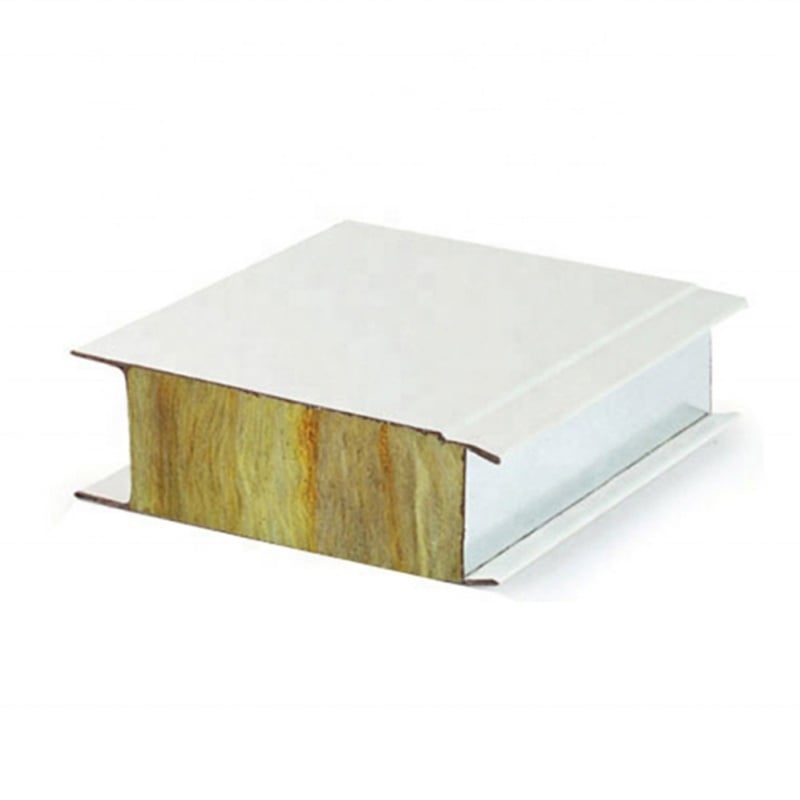
Rock wool is non-combustible (Class A1), which makes it the correct choice for any building where fire regulations prohibit combustible core materials — including pharmaceutical manufacturing, hospitals, food processing plants, and many commercial buildings in countries with strict building codes. From a pure thermal performance standpoint, rock wool is not ideal for hot climates: its lambda value (0.035–0.040 W/m·K) means you need significantly thicker panels to achieve equivalent insulation. But it is the realistic first choice whenever fire safety constraints apply.
EPS (Expanded Polystyrene) — Budget Option with Limitations
EPS is the lowest-cost core option. It provides reasonable thermal performance (lambda ≈ 0.038 W/m·K) and is widely available, but it has two significant limitations in hot-climate applications. First, EPS has a service temperature limit of around 75–80°C — meaning that in extreme conditions, an EPS roof panel under direct sun can approach this limit, leading to slow creep deformation of the core over time. Second, EPS is combustible and susceptible to some organic solvents used in industrial cleaning. For permanent buildings in hot climates, PIR or PU is generally a better investment.
Aluminum Honeycomb — Best for Cleanroom Ceilings
Aluminum honeycomb cores are non-combustible, extremely lightweight, and dimensionally stable at any temperature encountered in building applications. They are not a thermal insulation material in the traditional sense — their R-value per millimeter is much lower than foam cores — but their role in cleanroom ceilings (where they provide structural rigidity, not thermal insulation) makes them the standard specification for pharmaceutical and electronics cleanrooms regardless of climate.
| Core Material | Lambda (W/m·K) | Hot Climate Thermal | Fire Class | Max Service Temp | Relative Cost |
|---|---|---|---|---|---|
| PIR Foam | 0.022–0.024 | Excellent | B2 | 120°C | Medium-High |
| PU Foam | 0.022–0.028 | Very Good | B2 | 100°C | Medium |
| Rock Wool | 0.035–0.040 | Moderate | A1 | 750°C+ | Medium |
| EPS Foam | 0.036–0.040 | Moderate | B2/B3 | 75–80°C | Low |
| Aluminum Honeycomb | — | Low (structural) | A1 | 200°C+ | High |
3. Understanding U-Value and R-Value in Practice
Two numbers show up on every sandwich panel data sheet, and understanding what they actually mean for a hot-climate building is worth spending a few minutes on.
U-Value (Thermal Transmittance)
U-value measures how much heat flows through a panel per unit area per unit temperature difference — expressed in W/m²·K. Lower is better. A 100 mm PIR panel typically achieves a U-value of around 0.21–0.23 W/m²·K. A 100 mm rock wool panel achieves roughly 0.35–0.40 W/m²·K.
For hot-climate buildings, the target U-value depends on the application. For air-conditioned office or industrial buildings in the Middle East, a wall U-value of ≤ 0.35 W/m²·K is typically specified; for pharmaceutical cold rooms or food processing clean rooms, ≤ 0.20 W/m²·K is more appropriate.
R-Value (Thermal Resistance)
R-value is the inverse of U-value (R = 1/U) and is used more commonly in North American specifications. Higher R-value means better insulation. A 100 mm PIR panel with U = 0.22 W/m²·K has an R-value of approximately R-26 in US units — which is considered high-performance residential insulation by North American standards.
Don't overlook solar reflectance (SRI). U-value only describes conductive and convective heat transfer. In hot climates, radiant solar gain through the roof is often the dominant heat load — and this is controlled by surface color and coating, not U-value. A white or light-colored roof panel with SRI ≥ 78 (Cool Roof Rating Council standard) can reduce the effective solar heat gain by 50–60% compared to a dark-colored panel of identical thermal resistance.
4. How Panel Thickness Affects Cooling Load
Panel thickness is the simplest lever available to improve thermal performance. For hot-climate buildings, the standard 50 mm panel thickness common in many temperate-climate industrial buildings is rarely sufficient. Here's a practical reference for what thickness to target by application:
| Application | Recommended Min. Thickness (PIR/PU) | Recommended Min. Thickness (Rock Wool) | Notes |
|---|---|---|---|
| Industrial warehouse (ambient) | 75 mm | 100 mm | Reduce solar gain with light roof color |
| Air-conditioned office / retail | 100 mm | 150 mm | Wall and roof can differ; roof needs more |
| Pharmaceutical GMP cleanroom | 100 mm PIR not typical; use rock wool | 100–150 mm | Fire rating drives core choice over thermal |
| Cold room / refrigerated storage | 150–200 mm PU/PIR | Not recommended | Greater ΔT demands maximum insulation |
| Food processing cleanroom | 100 mm PU/PIR (check fire code) | 100 mm | Humidity management also critical |
One frequently overlooked fact: increasing panel thickness from 75 mm to 100 mm PIR typically reduces the thermal transmittance by roughly 25–30% while adding only 12–15% to panel material cost. On the scale of a full facility project, the energy savings over 10–15 years almost always justify the upfront premium — particularly in regions with high electricity costs for air conditioning.
5. Surface Finishes That Survive Harsh Sun
In temperate climates, a standard polyester (PE) painted steel skin performs acceptably for 10–15 years before showing significant fading or chalking. In the Middle East or tropical Southeast Asia, the same coating can start degrading visibly in 3–5 years. Choosing the right surface finish upfront is one of the most cost-effective decisions in a hot-climate specification.
PVDF (Polyvinylidene Fluoride) Coating
PVDF is the benchmark coating for hot, sunny, and coastal environments. Its UV resistance, color retention, and chalk resistance are superior to all other common architectural coatings. Leading systems such as Kynar 500® are rated for 20–25 years of exterior exposure in harsh climates with minimal maintenance. PVDF-coated steel skins add approximately 15–20% to panel skin cost but extend the effective service life by a factor of two or more compared to PE coatings in high-UV environments.
HDP (High-Durability Polyester)
A step up from standard PE, HDP coatings offer better UV and heat resistance at a lower premium than PVDF. They are a reasonable choice for wall panels (which receive less direct radiation than roofs) in hot climates, while PVDF remains the recommendation for roof panels.
Stainless Steel Skins (304 / 316L)
For pharmaceutical cleanrooms and food processing environments, stainless steel skins sidestep the coating durability question entirely — the material itself is inherently UV-resistant, chemical-resistant, and does not chalk or fade. Interior applications face no UV exposure, so for cleanroom wall and ceiling panels, stainless steel represents a lifetime cost advantage: zero recoating or resurfacing over the facility's life.
Color Selection for Hot Climates
Color choice is a thermal design decision, not just an aesthetic one. Light colors (RAL 9002, 9003, 9016) reflect 60–80% of solar radiation. Dark colors (RAL 7016 anthracite, RAL 6009 dark green) absorb 85–95%. On a roof panel, this difference can translate to a 10–15°C difference in surface temperature under peak solar load, which directly reduces cooling energy consumption and extends coating life.
Caution: Some project architects specify dark-colored facade panels for aesthetic reasons without considering the thermal load implications. In a hot-climate project, always run a thermal calculation showing the impact of color choice before agreeing to a dark facade. The cooling energy cost over 20 years can easily exceed the entire upfront cost of upgrading to a lighter-colored premium coating.
6. Fire Performance in High-Temperature Environments
Hot climates introduce a fire performance nuance that is often missed: the ambient temperature inside a building during a summer shutdown period — when air conditioning is off — can approach or exceed 60°C in some regions. At these temperatures, foam cores with low ignition temperatures or high thermal expansion are closer to their risk threshold than in temperate environments.
Standard PU and PIR foam panels achieve Class B2 (normal flammability) under European EN 13501-1 or equivalent national standards. This is acceptable for many building types, but not for:
- Pharmaceutical manufacturing (EU GMP Annex 1 buildings typically require A1 or B-s1,d0 minimum)
- Hospitals and healthcare facilities in most jurisdictions
- Buildings classified as high occupancy or assembly occupancy under local building codes
- Food processing facilities in countries with strict fire code enforcement
For these applications, the practical answer is almost always rock wool core panels — not because their thermal performance is optimal, but because they are non-combustible (A1) and satisfy the most stringent fire codes universally.
Practical approach: If your hot-climate project has fire rating requirements, determine the required fire resistance period (REI 30, 60, 90, 120 minutes) and specify rock wool panels accordingly. A 100 mm rock wool panel with MGO board skins can typically achieve REI 120. Then compensate for the lower thermal performance by increasing panel thickness rather than switching to a combustible core.
7. Dealing with Coastal Heat and High Humidity
Buildings in coastal hot-climate regions — think the Arabian Gulf, Singapore, Malaysia, West Africa, or the Caribbean — face a combination of heat, UV, salt air, and high humidity that is particularly demanding on sandwich panel systems. Several specific considerations apply:
Corrosion Resistance of the Steel Skins
Standard galvanized steel (G90 or Z275) is adequate for inland projects in dry hot climates. For coastal locations within roughly 1–5 km of the sea (depending on prevailing winds and elevation), the specification should step up to Galvalume (55% aluminium-zinc alloy coating) or pre-painted Galvalume, which offers significantly better salt-air corrosion resistance than standard galvanized steel. Beyond 500 m from breaking surf in highly aggressive marine environments, consider stainless steel skins for maximum longevity.
Condensation and Moisture Ingress
In humid tropical climates, condensation forms on the cold interior surface of panels in air-conditioned spaces — particularly at cold room facilities or pharmaceutical cleanrooms where interior temperatures are significantly below dew point. The panel edge seal system becomes critical in these applications. All four edges must be fully sealed with steel or aluminum extrusions and additional silicone to prevent moisture from wicking into the core. PU and PIR foams are closed-cell and largely moisture-resistant, but compromised edge seals create pathways that can cause long-term core degradation and even panel delamination.
Joint Sealing Under Thermal Movement
Hot climates cause significant thermal expansion and contraction of the steel panel skins — potentially 3–4 mm per 6-meter panel length across a daily cycle. Joint sealants must accommodate this movement without cracking. Polyurethane or silicone joint sealants with elongation-at-break ≥ 200% are recommended. Check that your installer is using the correct sealant specification rather than generic construction silicone.
8. Roof Panels vs. Wall Panels: Different Priorities
Roof panels and wall panels face genuinely different stresses in hot climates, and the optimal specification is not always the same product. Here's how the priorities differ:
| Factor | Roof Panel Priority | Wall Panel Priority |
|---|---|---|
| Solar load | Critical — direct perpendicular radiation | Moderate — oblique angle, partial shading |
| Thermal performance | Highest priority — specify thicker panels | Important but less critical than roof |
| Surface coating durability | PVDF minimum; white/light color strongly preferred | HDP acceptable; color has more flexibility |
| Structural loading | Wind uplift + maintenance access + water drainage | Wind pressure + impact resistance |
| Waterproofing | Primary concern — panel joints, flashings critical | Secondary — facade drainage manages most exposure |
| Recommended core (standard) | PIR or PU (where fire allows) | Rock Wool (fire zones) or PIR/PU (standard) |
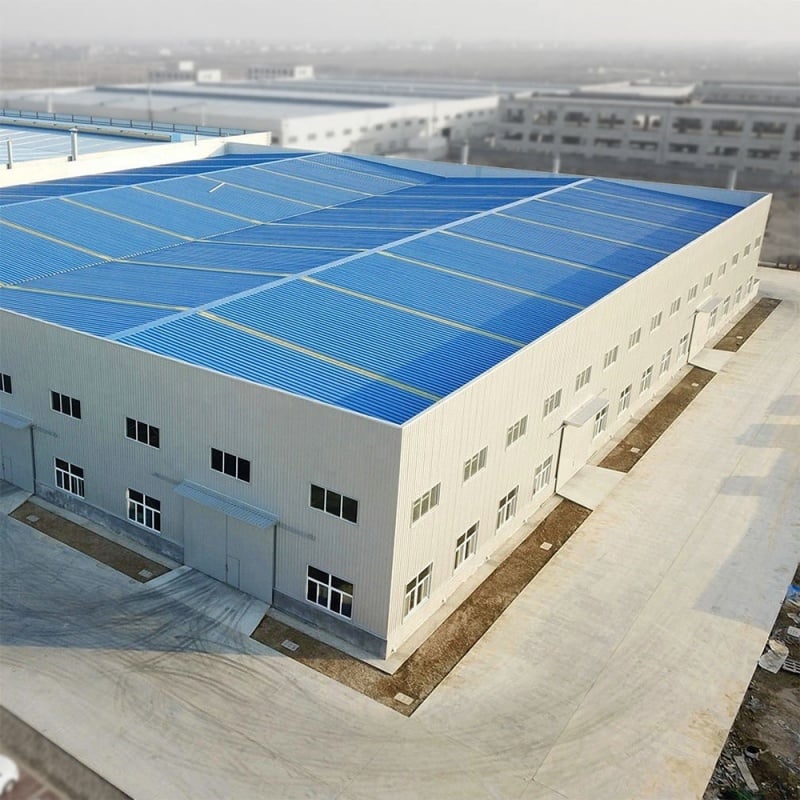
A common and cost-effective approach for hot-climate projects is to use high-performance PIR roof panels (100–150 mm, PVDF white coating) combined with rock wool or PU wall panels at a specification appropriate for the required fire rating, while specifying the wall panels in a lighter color to reduce facade heat absorption.
9. Cleanroom and Cold Chain Applications in Hot Climates
Pharmaceutical cleanrooms and food industry cold chain facilities in hot climates place the most demanding combination of requirements on sandwich panels: high thermal performance, regulatory fire compliance, surface hygiene, long-term structural integrity, and resistance to the humidity and temperature swings that come with operating a controlled environment inside a hot exterior shell.
▶ Video: Cleanroom sandwich panel installation detail
Pharmaceutical GMP Cleanrooms
The core specification for pharmaceutical GMP cleanrooms is almost always rock wool, irrespective of climate — fire regulations and GMP guidelines essentially mandate A1 non-combustible materials. The challenge in hot-climate GMP facilities is that the exterior shell (where rock wool panels face the outside environment) needs to work in concert with the HVAC system to manage the massive heat load before it enters the cleanroom.
In practice, this means the exterior structural walls of a hot-climate pharmaceutical facility are often designed as a separate high-performance thermal envelope (using PIR or PU insulation in the structural wall system) with the cleanroom panel system installed inside as an internal partition and ceiling layer. The cleanroom panels handle hygiene and air control; the structural envelope handles thermal performance.
Cold Room and Cold Chain Facilities
Refrigerated warehouses and pharmaceutical cold storage facilities in hot climates represent the most thermally demanding application for sandwich panels. A cold room in Dubai maintaining +2°C to +8°C while exterior temperatures reach 48°C creates a 40–46°C temperature differential across the wall — compared to perhaps 25°C in a northern European equivalent. Panel thickness requirements scale accordingly:
- Chilled rooms (+2°C to +8°C) in hot climates: 150 mm PU/PIR minimum
- Frozen storage (-18°C to -25°C) in hot climates: 200–250 mm PU/PIR
- Ultra-low temperature (-60°C to -80°C, biorepository): 250–300 mm PIR
Edge sealing and vapour barrier management are critical in these applications. The internal face of the panel is the "cold" surface, and any moisture penetrating the panel assembly from the warm exterior side will condense within the insulation core, progressively reducing thermal performance and potentially causing structural delamination over time.
10. 7-Point Selection Checklist for Hot-Climate Projects
Work through these seven questions before finalizing your panel specification:
What fire rating is required?
Confirm with your local authority. If A1 non-combustible is mandated, rock wool is your core — no exceptions. Only then evaluate thermal performance within that constraint.
What is your target U-value?
Run a basic heat load calculation or ask your MEP consultant. Set a maximum U-value target for both walls and roof, and confirm the panel specification achieves it at your chosen thickness.
What color will the roof be?
Default to white or light grey (SRI ≥ 78) unless there is a compelling reason otherwise. On roof panels in hot climates, color choice can matter as much as an extra 25 mm of insulation thickness.
What coating does the exterior skin need?
For roof panels in sun-exposed hot climates: PVDF minimum. For facades: HDP acceptable. For coastal within 5 km of the sea: Galvalume substrate rather than standard galvanized steel.
What is the humidity condition?
If the building interior is cold and the exterior is hot and humid, confirm the edge sealing specification and ensure the contractor uses the correct vapour-control joint detailing.
What connection and joint system?
For cleanroom or food industry interiors: concealed (hidden) connector with silicone-sealed joints. For industrial buildings: tongue-and-groove or standing seam roof systems.
Are doors and windows specified to the same standard?
A well-insulated panel wall is only as good as its weakest opening. Confirm that door and window thermal performance (U-value) and sealing details match the wall specification.
11. Frequently Asked Questions
Which sandwich panel core is best for the Middle East climate?
For non-fire-rated industrial and commercial buildings in the Middle East, PIR foam core panels are the top recommendation — they deliver the best thermal performance per millimeter, which directly reduces air conditioning running costs. For any building where local fire codes require non-combustible materials (hospitals, pharmaceuticals, certain commercial classifications), rock wool core becomes the required choice regardless of thermal performance trade-offs.
How much thicker should panels be in a hot climate compared to a temperate climate?
As a rough guide, increase panel thickness by 25–50% compared to a temperate-climate project with similar interior requirements. So if a warehouse in northern Europe would use 75 mm PU panels, a comparable facility in the UAE or Saudi Arabia should specify 100–120 mm. For cold rooms and pharmaceutical controlled environments, the increase is even more significant — often 50–100% thicker than equivalent temperate-climate specifications.
Can standard sandwich panels be used outdoors in hot, humid coastal regions?
Standard panels with G90/Z275 galvanized steel skins are not recommended for direct long-term coastal exposure. Specify Galvalume (AZ150 or AZ185 coating weight) skins as a minimum for within 5 km of the coast, and ensure all cut edges and fastener penetrations are treated with zinc-rich primer. For highly aggressive marine environments (within 500 m of breaking surf), stainless steel skins or specialized coated substrates should be considered.
Does panel color really make a significant difference to cooling costs?
Yes — significantly so, especially for roof panels. Studies consistently show that cool-colored roofs (SRI ≥ 78) reduce roof surface temperatures by 20–30°C compared to dark roofs in equivalent solar conditions, reducing the heat conducted through the roof by a proportional amount. In a hot-climate warehouse with poor natural ventilation, switching from a dark to a light-colored roof can reduce cooling energy consumption by 15–25%. The payback on the minor color premium (if any) is typically well under one year.
What is the minimum panel thickness for a pharmaceutical cleanroom in a hot climate?
For a standard GMP pharmaceutical cleanroom interior (where the thermal envelope is handled by the structural building shell), rock wool panels of 50–100 mm are used for the internal wall and ceiling system. If the cleanroom panel system is also the primary building envelope (common in modular or prefabricated cleanroom buildings), 100 mm rock wool panels are typically the minimum, with 150 mm specified where the design analysis shows higher U-value requirements due to extreme exterior conditions.
How long do PVDF-coated sandwich panels last in hot, sunny climates?
PVDF coatings from reputable manufacturers are rated for 20–25 years of color retention and chalk resistance in high-UV environments, backed by manufacturer warranties. In the Middle East and Southeast Asian climates, installed PVDF-coated panels from established manufacturers have consistently demonstrated performance matching or exceeding these ratings. Standard PE coatings, by contrast, typically show significant visible degradation (chalking, fading) within 5–8 years in the same environments.
Is PIR foam safe to use in buildings — is it a fire risk?
PIR is classified as Class B2 (normal flammability) under EN 13501-1 — the same classification as many other common building materials including timber framing. In a properly designed building with appropriate fire compartmentalization, sprinkler systems, and compliant structural design, PIR panels are widely used and code-compliant in the vast majority of industrial, commercial, and logistical building types globally. They are not appropriate where the building code explicitly requires A1 non-combustible core, as discussed in Section 6 above.
Need Help Specifying Panels for Your Hot-Climate Project?
Our technical team works with project owners, consultants, and contractors across the Middle East, Southeast Asia, and Africa to specify the right sandwich panel system for each project's climate, fire, and regulatory requirements.
Request a Technical Consultation →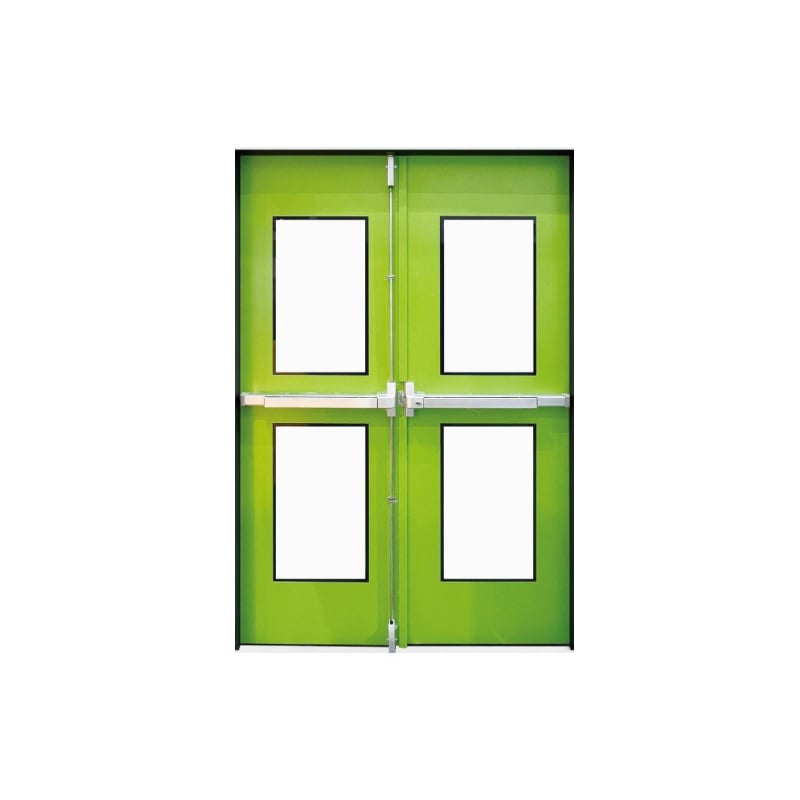
 Hot News