Industrial noise is not just a nuisance — it is a documented occupational health risk, a productivity drain, and increasingly a regulatory compliance issue in markets from the Middle East to Southeast Asia. Yet when procurement managers begin specifying envelope materials for a new manufacturing plant, power station, or processing facility, acoustic performance is rarely the first line on the spec sheet.
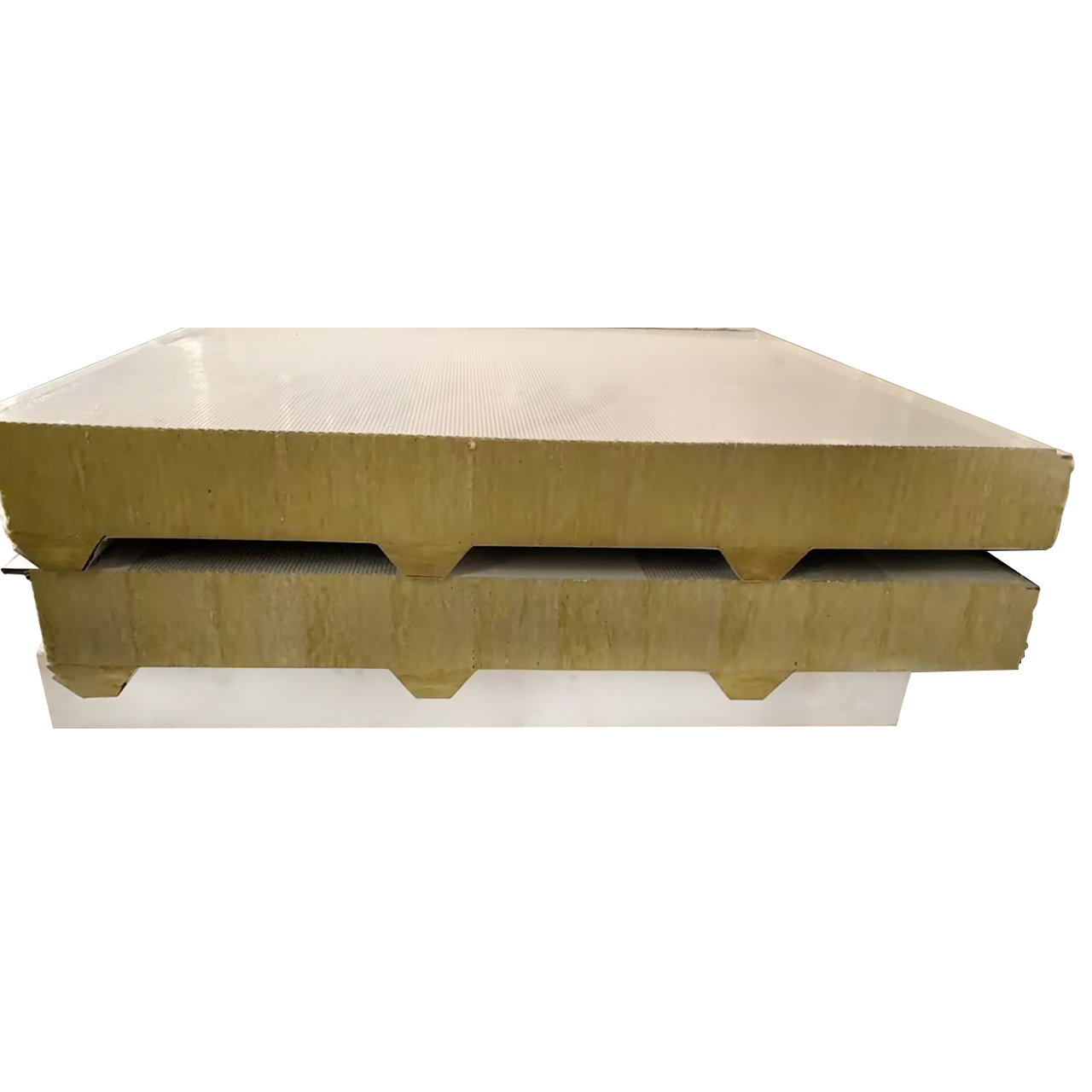
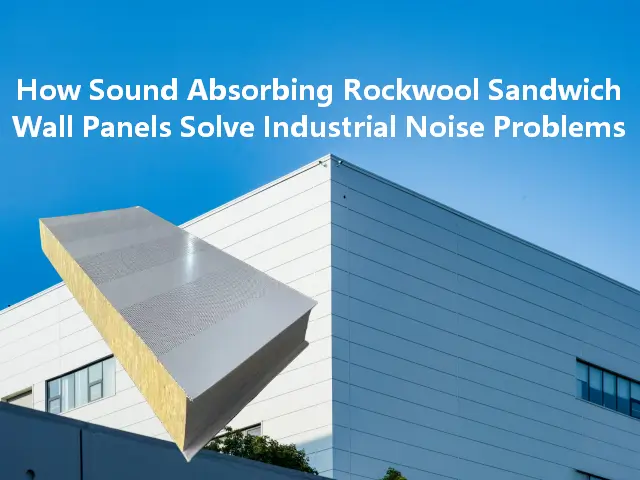
This article explains why that needs to change, what actually makes a wall panel acoustically effective, and how to evaluate sound absorbing rockwool sandwich wall panels — a product category that delivers measurable noise reduction alongside the thermal insulation and fire safety already expected from modern sandwich panels.
Walk the floor of a typical manufacturing plant — motor noise, compressor discharge, conveyor lines, ventilation fans — and ambient sound pressure levels routinely sit between 70 and 90 dB. At 70 dB, the U.S. EPA considers this the upper threshold for human tolerance without long-term health consequences. By 80–85 dB, international occupational health standards (including ISO 9612 and ILO guidelines widely referenced in Gulf Cooperation Council project specifications) begin mandating engineering controls.
Standard PU or EPS sandwich panels are excellent thermal insulators. A 50 mm PU panel offers roughly Rw = 26–28 dB of sound transmission loss — adequate to reduce noise passing between spaces, but it does nothing to address noise within the same space. Sound reflecting off hard, smooth steel faces bounces around the building interior, builds up reverb energy, and keeps noise levels elevated even when the source itself is not exceptionally loud.
This is the gap that acoustic sandwich panels are designed to fill: walls that not only block sound transmission but actively absorb reverberant energy inside the building envelope.
These two terms appear on every acoustic data sheet, but they measure fundamentally different things — and confusing them leads to under-specified buildings.
| Metric | What It Measures | Why It Matters |
|---|---|---|
| NRC (Noise Reduction Coefficient) | Percentage of incident sound energy absorbed by the panel surface (0 = total reflection, 1.0 = total absorption) | Controls reverb inside the building — reduces noise levels within the same space as the source |
| Rw (Weighted Sound Reduction Index) | How many decibels of sound are blocked from passing through the panel to the adjacent space | Controls noise transmission between spaces — critical for neighbor compliance and zoning |
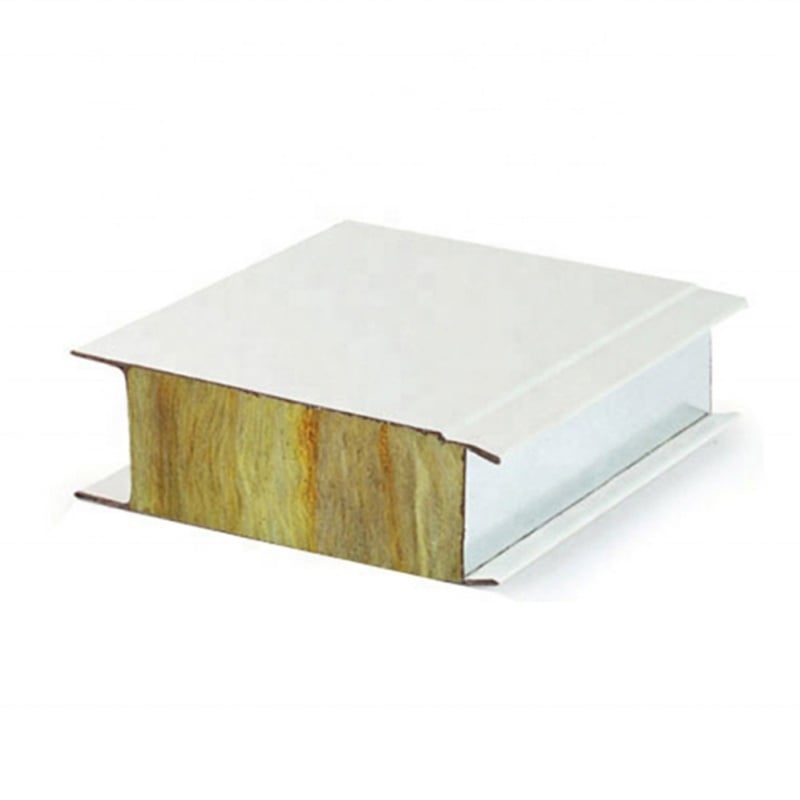
A standard smooth-face rockwool sandwich panel has an NRC in the range of 0.05–0.10 (highly reflective steel surface) and Rw around 30–32 dB. A sound absorbing rockwool sandwich panel with a perforated inner steel face and acoustic non-woven facing achieves NRC = 0.75 — meaning it absorbs 75% of incident sound energy — while maintaining Rw = 34 dB. For high-frequency industrial noise in the 3,150–5,000 Hz range (characteristic of fans, compressors, and motors), the insulation value climbs further to 40–50 dB.
Not all sandwich panel cores perform equally for acoustic applications. The comparison is straightforward:
| Core Material | Acoustic Performance | Fire Rating | Moisture Resistance |
|---|---|---|---|
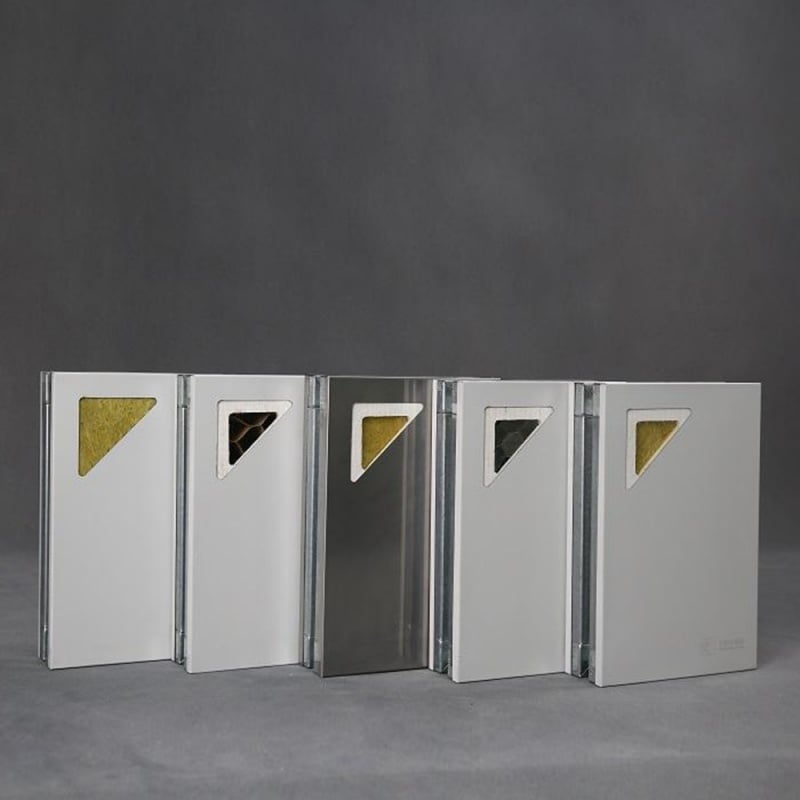
| Rock Wool (100–120 kg/m³) | Excellent — porous fibrous structure absorbs broadband noise effectively | Class A (non-combustible) | High (hydrophobic treatment, waterproof rate ≥98%) |
| Glass Wool | Good at mid-high frequency, but lower density limits low-frequency performance | Class A | Moderate — more susceptible to moisture-induced degradation |
| PU / PIR Foam | Poor — closed-cell foam reflects rather than absorbs sound | Class B–C (combustible) | Excellent thermal, but not an acoustic solution |
Rock wool's fibrous, open-pore structure converts acoustic energy into heat through friction as sound waves pass through the material. At a density of 100–120 kg/m³, it provides sufficient mass and flow resistance to perform across the 100–5,000 Hz range that covers the majority of industrial machinery noise profiles. It is also the only core material that simultaneously satisfies Class A fire requirements — a non-negotiable specification in most GCC, Southeast Asian, and increasingly South American industrial project codes.
The perforated steel inner face is the defining design feature of a sound absorbing sandwich panel. However, not every perforation pattern delivers the same result. Key parameters that determine acoustic performance include:
| Design Parameter | Optimized Value | Why It Matters |
|---|---|---|
| Hole Diameter | 3 mm | Optimized for mid-to-high frequency industrial noise; smaller holes target higher frequencies |
| Hole Center Spacing | 5 mm | Controls open-hole rate; spacing too large reduces acoustic performance, too small weakens the panel structurally |
| Hole Arrangement | 60° staggered grid | Maximizes open area for a given hole size while distributing stress evenly across the steel face |
| Open-Hole Rate | 32.7% | The proportion of the face that is open to the rock wool core; the primary driver of NRC value |
| Adhesive Zone | Non-perforated strips only | Bonding only in solid areas preserves the porous absorption pathway through the perforated zones — bonding across holes would block the acoustic mechanism |
The result is a panel that achieves NRC = 0.75 with bending load capacity equal to standard non-perforated panels — confirmed by third-party structural testing. Procurement managers do not need to trade off acoustic performance against façade structural requirements.
A facility measuring 68 dB at the work floor — a typical light manufacturing environment — can expect reductions of approximately 15–20 dB in reverberant noise energy following installation of sound absorbing rockwool sandwich wall panels across the building envelope. This shifts the acoustic environment from the GB 3096-2008 Class 3 industrial zone (65 dB limit) toward Class 1 residential standard (55 dB limit).
In practical terms for a procurement manager evaluating total project value, this translates to:
| Benefit Area | Operational Impact |
|---|---|
| Occupational Health Compliance | Reduces exposure levels below mandatory PPE thresholds; lowers liability exposure in jurisdictions with strict noise regulations (Saudi Arabia OSHA, UAE Federal Law No. 8) |
| Worker Productivity | Studies indicate error rates in precision operations drop significantly when ambient noise falls below 70 dB; reduced fatigue and improved concentration |
| Neighbor & Community Compliance | Rw = 34 dB insulation helps meet municipal noise emission limits at the property boundary — increasingly enforced in GCC industrial zones |
| No Additional Acoustic Treatment | Combines thermal insulation, fire protection, and acoustic performance in a single panel — eliminating the cost and complexity of separate acoustic lining systems |
Not all panels marketed as "acoustic" or "soundproof" deliver equivalent performance. When evaluating suppliers, procurement managers should request the following documentation and specifications:
| NO. | Specification Item | What to Look For |
|---|---|---|
| 1 | Third-party NRC test report | Results across the full 100–5,000 Hz range, not just a single frequency; NRC ≥ 0.70 for industrial applications |
| 2 | Weighted Rw value | Minimum Rw = 32 dB for general industrial; Rw ≥ 34 dB preferred for high-noise environments |
| 3 | Fire classification certificate | Class A (non-combustible core) per EN 13501-1 or equivalent national standard |
| 4 | Rock wool density confirmation | Minimum 100 kg/m³; higher density (120 kg/m³) improves low-frequency absorption |
| 5 | Open-hole rate of inner face | ≥ 30% open area; lower rates significantly reduce NRC performance |
| 6 | Structural bending test | Confirms perforated face maintains equivalent load capacity to non-perforated panels |
| 7 | Hydrophobic treatment data | Waterproof rate ≥ 98% for the rock wool core; critical for humidity-prone environments |
Industrial noise control is moving from a compliance afterthought to a front-end design requirement — driven by tightening occupational health regulations, growing awareness of productivity costs, and increasing neighbor-noise enforcement in industrial zones across the Middle East, Southeast Asia, and South America.
Sound absorbing rockwool sandwich wall panels offer procurement managers a single-product answer to what has traditionally required multiple material layers: thermal insulation, Class A fire protection, structural facade performance, and now NRC = 0.75 broadband acoustic absorption. The key is selecting panels with validated perforation engineering, verified third-party acoustic data, and production consistency — not just a marketing label that says "soundproof."
Related product links: https://www.cnapex.net/sound-absorbing-rockwool-sandwich-wall-panels
Specify the Right Acoustic Panel for Your Project
Glostar supplies sound absorbing rockwool sandwich wall panels from our Shandong facility, with full third-party test documentation, custom thickness and color options, and export experience to the Middle East, Southeast Asia, and South America. Send us your facility type, floor area, and current noise level — we will recommend the appropriate panel specification and provide a competitive FOB quotation.
Contact: [email protected]
 Hot News
2026-09-09
2026-08-14
2026-08-11
2026-08-06
2026-07-30
2026-07-20

We believe that by upholding quality and embracing innovation, we can drive transformative changes in architecture and build a sustainable future for the construction industry.
No. 377, Gaoqi Road, High-tech Zone, Binzhou City, Shandong Province, China
Copyright © Shandong Apex Metal Products Co., Ltd. All Rights Reserved (Under the Glostar New Materials Group) Privacy Policy Blog
 EN
EN