Choosing a cleanroom panel sounds simpler than it is. Most manufacturers publish product pages that look broadly similar — two steel skins, an insulating core, various thickness options, a list of applications. What those pages don't tell you is why one specification works for a pharmaceutical fill-finish suite and a different one is the correct choice for an electronics assembly room, or why the same panel type that holds up perfectly in a European facility can fail prematurely when installed in a humid tropical climate.
The decisions that matter — core material, surface coating, edge treatment, joint system, panel thickness — are interconnected in ways that aren't obvious until something goes wrong. A pharmaceutical plant that specified the wrong surface coating discovers the problem when the coating starts to degrade under VHP disinfection cycles. A food processing cleanroom that skimped on edge sealing ends up with mineral wool fibers in the production environment. These aren't hypothetical scenarios; they're the kinds of problems that drive facility renovation projects years ahead of schedule.
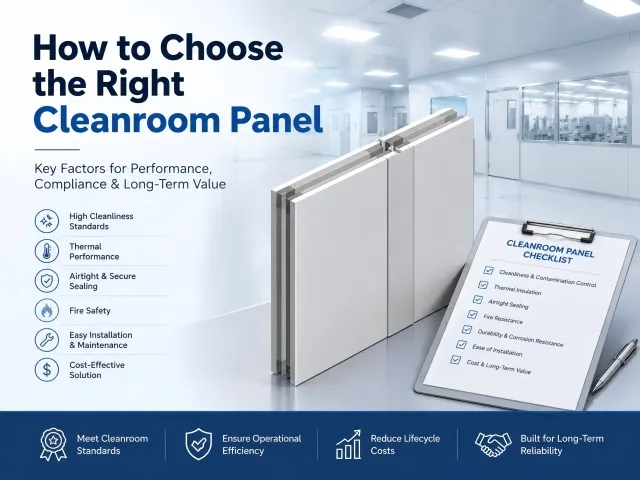
This guide is written for project owners, EPC contractors, and procurement teams working through a cleanroom panel specification for the first time. It covers each decision point in order, with enough context to understand why it matters, not just what to specify.
The single most common mistake in cleanroom panel procurement is starting with a product and working backward. A supplier quotes a 50 mm rock wool panel, it looks reasonable, and it gets specified — without anyone asking whether 50 mm is actually sufficient for the thermal load, or whether rock wool is even required by the fire code, or whether the application calls for a different connection system entirely.
Before looking at any product, answer these four questions. They will determine most of your specification before you've spoken to a single supplier.
ISO 14644, EU GMP Annex 1, FDA 21 CFR, WHO GMP, ISO 13485, BRCGS — each one implies different surface, fire, and documentation requirements. Write this down before doing anything else. If the standard isn't yet defined, that's the first problem to solve, not the second.
EU GMP and most national fire codes for pharmaceutical facilities require Class A1 non-combustible materials. If your project falls into this category, rock wool or aluminum honeycomb is the core — that decision is made for you. If not, you have more flexibility, and thermal performance becomes the leading criterion.
This determines your surface coating choice more than anything else. Standard PE-coated panels hold up under IPA wiping once a day. They degrade much faster under VHP (hydrogen peroxide vapor) cycles or frequent chlorine-based cleaning. Get clarity on your disinfection protocol before specifying the skin coating.
Hot-climate projects need thicker insulation, UV-stable coatings, and in coastal areas, corrosion-resistant substrates. A panel spec appropriate for Germany may underperform significantly in Saudi Arabia or Vietnam without adjustments. Answer this early.
Practical note: When you bring these four answers to a supplier, the conversation changes. Instead of getting a standard product recommendation, you get a specification that's been filtered through your actual constraints — and you can compare suppliers' responses to the same set of requirements rather than trying to compare disparate catalogs.
The core is the structural and thermal heart of the panel. It determines fire classification, thermal insulation value, acoustic performance, weight, and — critically — whether the panel can even be used in certain regulated environments. Here is a clear-eyed assessment of each option.
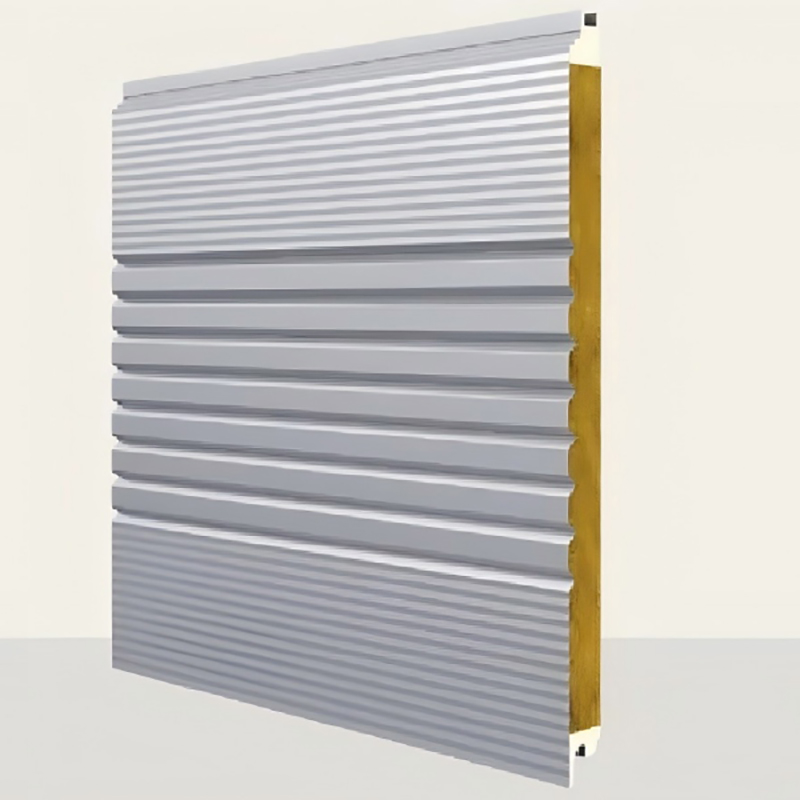
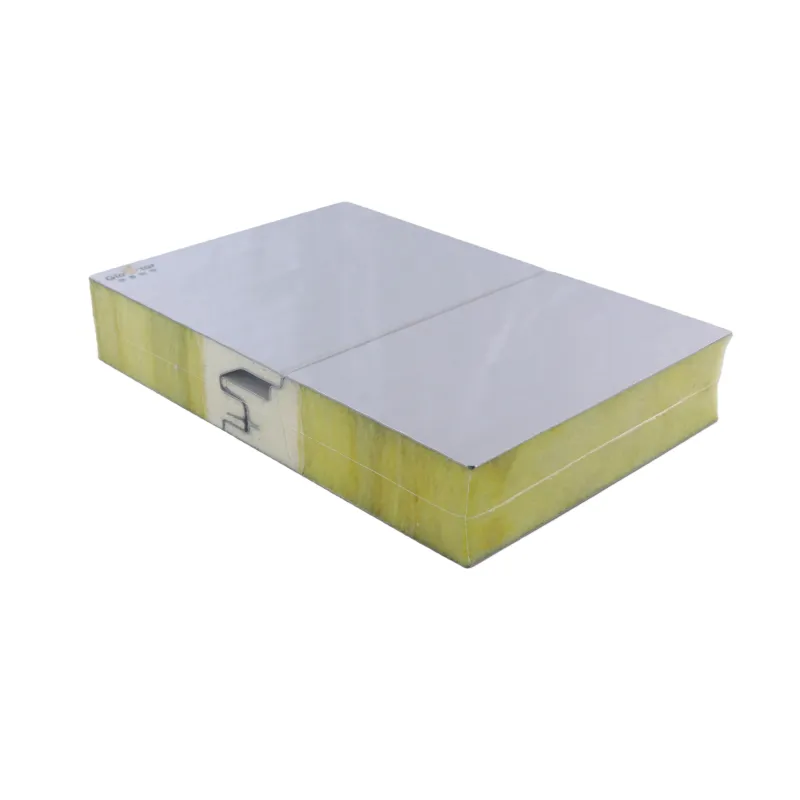
Rock wool is made from molten basalt rock spun into fibers, then bonded and compressed into rigid slabs. Its defining property is that it doesn't burn — it achieves Class A1 (non-combustible) under EN 13501-1, which is the highest fire classification available. A 50 mm rock wool panel typically achieves REI 60 (60 minutes structural fire resistance); a 100 mm version can reach REI 120 to REI 240.
For pharmaceutical manufacturing, hospital operating rooms, and food processing facilities — essentially anywhere a regulatory authority will inspect the building — rock wool is the default core choice precisely because fire compliance is non-negotiable and rock wool satisfies it unambiguously. The trade-off is weight (heavier than foam cores) and thermal performance (lambda ≈ 0.035–0.038 W/m·K, versus 0.022–0.024 for PIR). For most cleanroom partition applications, the thermal performance gap doesn't matter — the building's thermal envelope is handled by the structural shell, not the internal partition panels.
Best for: Pharmaceutical (GMP), hospitals, food processing, any project where A1 fire classification is required
Density to specify: 100–150 kg/m³ for GMP cleanrooms — ask for mill certificate confirmation. Below 80 kg/m³ is inadequate for regulated environments.
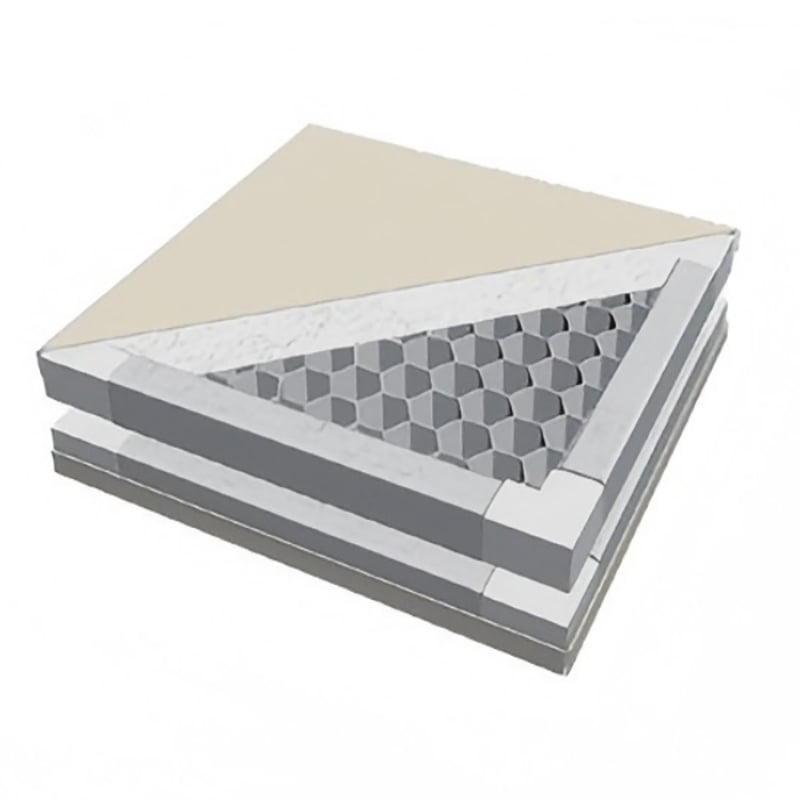
Aluminum honeycomb is the standard core for cleanroom ceiling panels. The hexagonal cell structure delivers an exceptional strength-to-weight ratio — a ceiling panel needs to be rigid enough that maintenance personnel can walk across it during HVAC or filter servicing, while being light enough not to overload the suspension system. Aluminum honeycomb achieves both. It's also non-combustible (A1), completely inert, and produces zero particulate shedding.
Aluminum honeycomb is not a meaningful thermal insulator — its R-value per millimeter is far lower than any foam core. For cleanroom ceilings, this isn't a problem because the thermal function is served by the plenum above the ceiling, not the ceiling panel itself. For wall applications, rock wool is generally preferred over aluminum honeycomb unless extreme weight constraints apply.
Best for: Cleanroom ceiling panels across all sectors — pharmaceutical, semiconductor, food, hospital
PIR (polyisocyanurate) and PU (polyurethane) foam cores provide the best thermal insulation performance available in a sandwich panel. PIR has a lambda value of 0.022–0.024 W/m·K — roughly 50% better than rock wool at the same thickness. For applications where thermal performance is the primary driver and A1 fire classification is not required by code, PIR and PU are the correct choice: cold chain pharmaceutical storage, food processing cold rooms, temperature-controlled logistics facilities.
Both materials are classified as combustible (Class B2 at best under EN 13501-1). For this reason they cannot be used as the primary wall or partition material in pharmaceutical GMP facilities, hospitals, or other buildings where fire codes mandate non-combustible construction. Attempting to substitute PU panels for rock wool in a GMP facility to save cost is the kind of decision that becomes very expensive when the facility goes through regulatory inspection.
Best for: Cold rooms, refrigerated warehouses, temperature-controlled cleanrooms where fire code permits combustible cores
Paper honeycomb is an economy ceiling and partition panel core — adequate for lower-classification cleanrooms (ISO 7–9) where fire requirements are modest. EPS (expanded polystyrene) is the lowest-cost foam core option, suitable for basic industrial or commercial applications but not for GMP or regulated food environments. EPS has a service temperature ceiling of approximately 75–80°C, which can be approached on hot days in roof panels under direct sun.
| Core | Fire Class | Lambda (W/m·K) | Weight | GMP Pharma? | Cost |
|---|---|---|---|---|---|
| Rock Wool | A1 ✓ | 0.035–0.038 | Heavy | Yes ✓ | Medium |
| Aluminum Honeycomb | A1 ✓ | Low (structural) | Very light | Yes (ceiling) ✓ | High |
| PIR / PU Foam | B2 | 0.022–0.028 | Light | No (fire code) | Medium |
| Paper Honeycomb | B | Low | Light | Limited use | Low |
| EPS | B2/B3 | 0.036–0.040 | Very light | No | Very low |
The interior surface of a cleanroom panel is what your operators see, touch, and clean every shift for the next 20–30 years. It's also what an FDA or EU GMP inspector looks at during an audit. Getting the surface specification wrong is less dramatic than getting the fire rating wrong, but the cumulative cost — in shortened panel life, failed inspections, and unplanned renovation — can be substantial.
PVDF is the benchmark surface coating for cleanroom environments where chemical disinfection is aggressive or frequent. Its UV resistance, color retention, and chemical stability are significantly better than polyester coatings — which is why it's the standard specification for pharmaceutical GMP cleanrooms and increasingly for food processing facilities that use chlorine-based or oxidizing disinfectants.
Leading PVDF systems are rated for 20+ years of color retention in outdoor exposure testing. In cleanroom environments (indoor, UV-protected), they perform even better. The cost premium over standard PE coating is roughly 15–20% on the panel price — typically well justified over a 25-year facility lifetime when the alternative is recoating or panel replacement at year 8.
Standard PE coatings are adequate for lower-grade cleanrooms (ISO 7–9) using moderate cleaning agents (IPA, mild quaternary ammonium disinfectants) at moderate frequency. They're not suitable for aseptic pharmaceutical manufacturing, operating rooms, or any environment using VHP, strong oxidizing agents, or high-concentration chlorine solutions. If in doubt about the cleaning protocol, specify PVDF.
Stainless steel skins bypass the coating question entirely. The material itself is chemically resistant, non-corrosive, and immune to the surface degradation that eventually affects all painted steel surfaces. It's specified for cytotoxic drug manufacturing, high-potency API areas, food processing washrooms with high-pressure hot-water cleaning, and any application where the facility team wants to eliminate recoating from the long-term maintenance schedule.
Grade 304 is standard. Grade 316L offers better chloride resistance and is worth specifying in coastal installations or facilities using chlorine-heavy cleaning regimes. Typical finish is No. 4 brushed or 2B for cleanroom applications — smooth enough to clean, matte enough to avoid glare for operators.
Panel color in a cleanroom isn't purely aesthetic. White (RAL 9002, 9003, or 9016) is standard for pharmaceutical and medical cleanrooms — it makes contamination visible and reflects light effectively, reducing eye strain in windowless production suites. For exterior-facing panels in hot climates, white or light grey (RAL 7035) dramatically reduces solar heat gain compared to darker colors, with a direct impact on cooling energy consumption.
| Surface Type | Suited For | Not Suited For |
|---|---|---|
| PVDF-coated steel | GMP pharma, hospital OR, aggressive disinfection, hot climate exterior | — |
| PE-coated steel | ISO 7–9, mild cleaning, cost-sensitive industrial cleanrooms | VHP environments, EU GMP Annex 1 Grade A/B, long-term aggressive disinfection |
| Stainless steel 304 | High-potency API, food washrooms, facilities eliminating paint maintenance | Budget-sensitive projects; coastal with chloride exposure (use 316L instead) |
| Stainless steel 316L | Coastal environments, chlorine-heavy cleaning, cytotoxic manufacturing | Projects where 304 provides adequate corrosion resistance |
Thickness determines thermal insulation value, fire resistance duration, structural rigidity, acoustic performance, and to some extent panel weight. The trade-offs between these properties look different depending on whether you're specifying a wall or ceiling panel, and what the application is.
For cleanroom partition walls in pharmaceutical GMP facilities, 75–100 mm is the standard range. 50 mm is technically sufficient in some lower-grade applications but provides limited acoustic separation and a shorter fire resistance period. 100 mm rock wool provides REI 120 or better and Rw ≥ 38 dB — both useful in pharmaceutical manufacturing environments where noise separation between production areas is often required.
For ceiling panels, the thickness decision is driven primarily by the span between supports and the maintenance access requirement — not thermal insulation. Aluminum honeycomb ceiling panels at 50 mm provide adequate rigidity for standard ceiling spans with maintenance access.
| Application | Recommended Thickness | Notes |
|---|---|---|
| GMP pharma wall (EU GMP) | 100 mm rock wool | REI 120+, Rw ≥ 38 dB |
| Standard cleanroom wall (ISO 6–8) | 50–75 mm rock wool | REI 60, adequate for most fire codes |
| Cleanroom ceiling | 50 mm aluminum honeycomb | Weight critical — honeycomb vs. rock wool |
| Cold room / refrigerated cleanroom | 150–200 mm PU/PIR | Temperature delta drives thickness requirement |
| Hot-climate facility (exterior shell) | +25–50 mm vs. temperate spec | Solar load requires uprated insulation |
This is the detail that most clearly separates a cleanroom panel from a standard sandwich panel — and the detail that's most often inadequately specified or inspected during procurement.
A standard industrial sandwich panel leaves its cut edges open or minimally covered, exposing the core material. For a warehouse, this is irrelevant. For a cleanroom — especially one with a rock wool core — it means the fibrous core is in direct contact with the room interior, and fibers will continuously migrate into the controlled environment. This is an automatic disqualification in pharmaceutical and food processing environments.
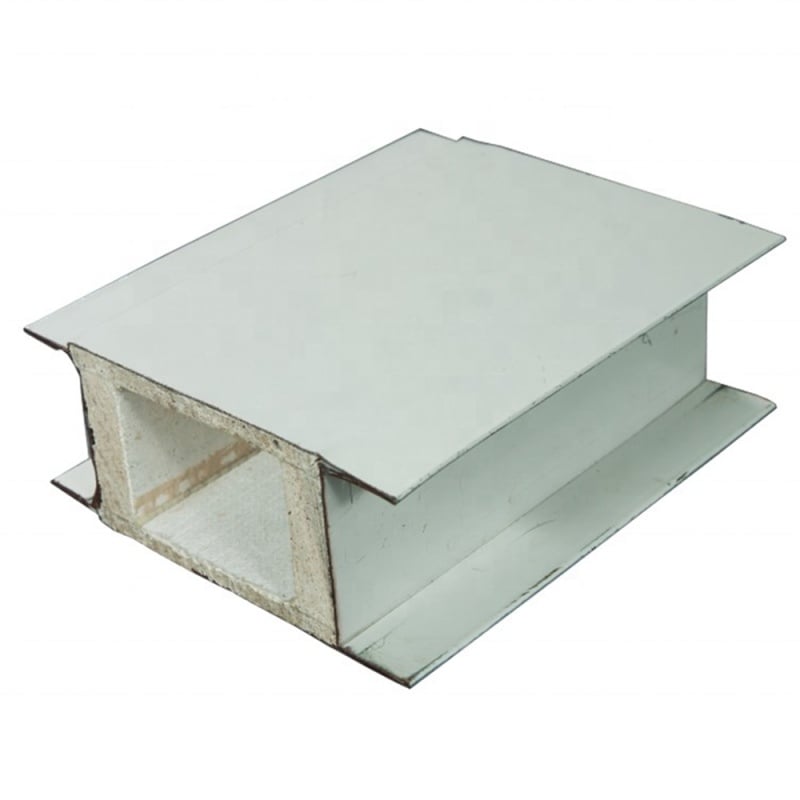
A properly made cleanroom panel has all four edges sealed with formed steel or aluminum channel sections, fully enclosing the core. When you evaluate samples from a supplier, this is the first physical thing to check — turn the panel over and inspect every edge. Any visible gap between the channel and the panel face, or any exposed core material at a corner, is a quality failure.
The most hygienic and most specified joint system for pharmaceutical and medical cleanrooms. A profiled metal connector sits inside the joint gap between two panels — invisible from the room interior. The narrow surface gap is sealed with food-grade silicone. There are no exposed fasteners, no screw heads, no grooves that can trap particles or make cleaning difficult. This is what EU GMP inspectors expect to see in Grade B and Grade C pharmaceutical production areas.
Faster to install than a concealed connection system, and adequate for ISO 7–9 cleanrooms and lower-grade food processing environments. The interlocking profile provides a reasonably tight joint that can be silicone-sealed on the room interior. Less hygienic than a true concealed system because the joint geometry is more complex to clean and can accumulate soil in service.
Uses aluminum or steel H-channel extrusions to connect panels at their edges, with compression gaskets providing the airtight seal. This system is preferred where the cleanroom may need to be reconfigured in the future — H-channel connections can be disassembled and panels relocated more easily than bonded or concealed connection systems. The trade-off is that the H-channel profile creates a visible surface feature that is more complex to clean thoroughly.
Critical installation note: The silicone sealing stage determines whether the cleanroom passes its commissioning airtightness test. Every panel joint, every penetration for electrical conduits or pipe work, and every transition between panels and the floor or ceiling structure must be sealed. Inexperienced installers frequently underestimate the number of sealant points involved — which is one reason commissioning airtightness tests fail more often than expected in new-market projects.
One of the more common specification errors is treating ceiling and wall panels as interchangeable, or assuming that because the same manufacturer makes both, the same product specification is appropriate for both applications. The functional requirements actually differ quite significantly.
Wall panels need to be stiff enough to resist lateral loads and impact, heavy enough that they seat solidly in floor channels without racking, and acoustically dense enough (particularly for rock wool cores) to provide the required sound separation. For pharmaceutical GMP walls, the rock wool density of 100–150 kg/m³ is important not just for fire performance but also for acoustic performance and long-term dimensional stability.
Ceiling panels have an additional constraint that wall panels don't: they need to safely support a person standing or walking on them. HVAC servicing, filter replacement, and lighting maintenance all require ceiling access — and in many pharmaceutical facilities, this means personnel walking across the ceiling panel surface on a regular basis. Aluminum honeycomb panels at 50 mm thickness provide the structural rigidity to support maintenance access loads while remaining light enough (6–9 kg/m²) not to overload the suspension structure.
Rock wool ceiling panels are technically possible but weigh approximately 18–22 kg/m² at 100 mm thickness — substantially more than aluminum honeycomb. For facilities with large ceiling areas, this weight difference can have significant structural and installation cost implications. The additional fire performance of rock wool (over aluminum honeycomb, which is also non-combustible) rarely justifies the weight premium for ceiling applications.
| Priority | Wall Panel | Ceiling Panel |
|---|---|---|
| Recommended core | Rock wool (GMP) or PIR (cold room) | Aluminum honeycomb |
| Fire classification | A1 required (GMP/hospital) | A1 (honeycomb is non-combustible) |
| Weight concern | Less critical | High — suspension load design |
| Maintenance access load | N/A | Critical — person-load rating needed |
| Acoustic priority | High (zone separation) | Lower (plenum manages most separation) |
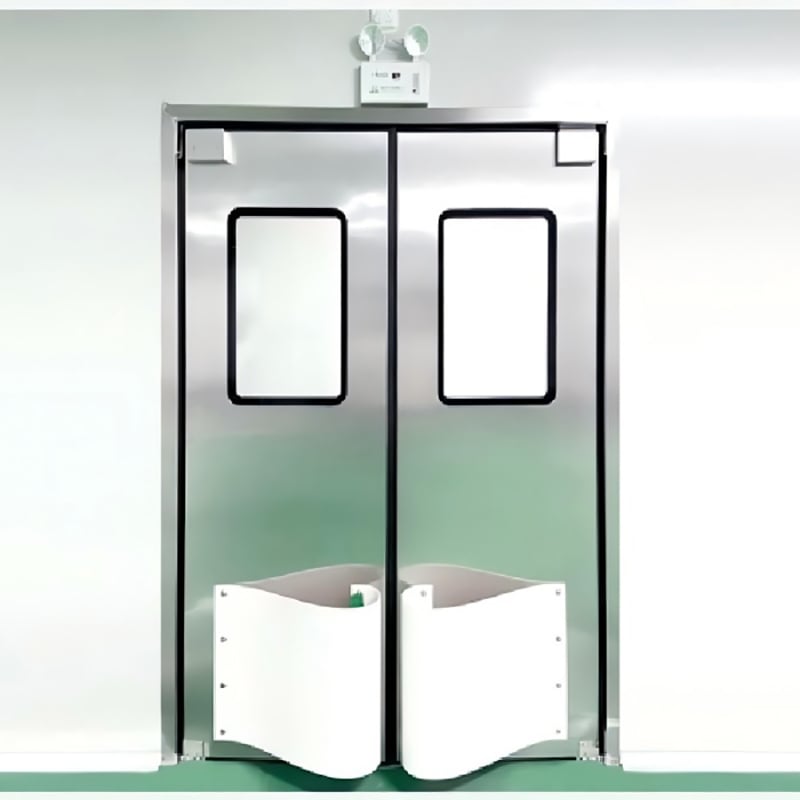
Cleanroom panels can be specified and manufactured impeccably, and the cleanroom can still fail its airtightness test — because of the doors and windows. Openings are the weakest points in any envelope system, and in a cleanroom they need to be engineered to the same standard as the panels they're installed in.
One practical point on system sourcing: cleanroom doors and windows should come from the same supplier as the panels. The door frame profile is designed to interface with the specific panel edge and thickness — mixing components from different suppliers creates dimensional mismatch problems that have to be resolved on site, usually under time pressure. Glostar supplies panels, doors, windows, corner pieces, and connection hardware as a complete system for exactly this reason.
Panel specifications developed for temperate European climates don't automatically transfer to projects in Southeast Asia, the Middle East, or tropical Africa. Several specific adjustments are worth reviewing for any project in a hot or coastal climate.
🌡️ High Ambient Temperature
Increase wall insulation by 25–50% relative to temperate specifications. For roof panels, specify PVDF coating in white or light grey (SRI ≥ 78) to minimize solar heat gain. The color choice on a roof panel can matter as much as an extra 25 mm of insulation thickness.
🌊 Coastal / Marine Environment
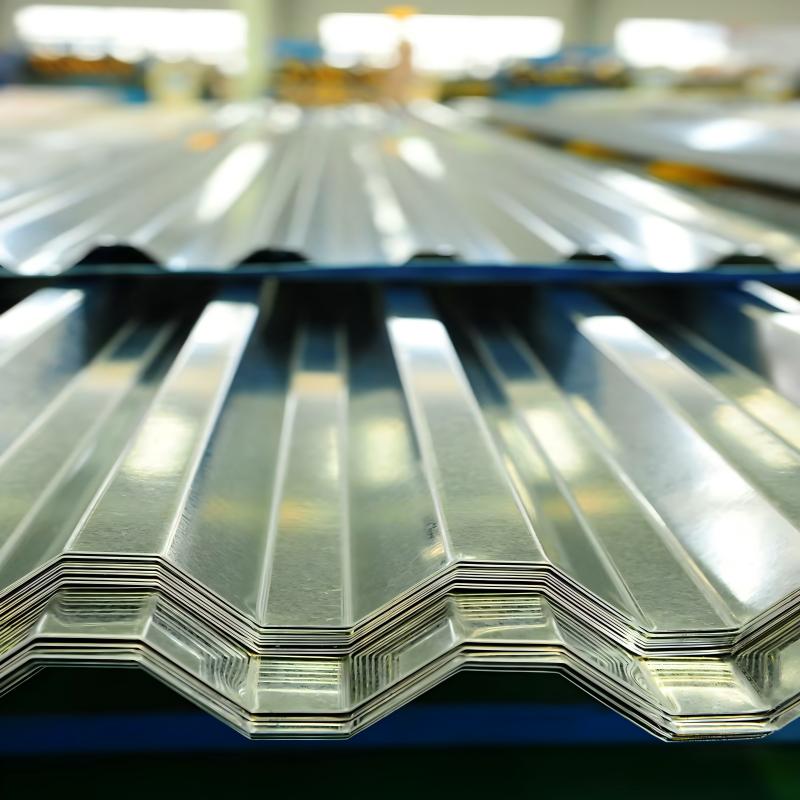
Standard G90/Z275 galvanized substrate is not adequate for within 5 km of the coast. Specify Galvalume (AZ150 or AZ185) substrate as minimum. Within 500 m of breaking surf, stainless steel skins or specialized marine-grade coatings should be evaluated.
💧 High Humidity (Tropical)
In cold room applications in tropical climates, the temperature differential across the panel is extreme — 40°C or more. Edge sealing integrity is critical: any moisture pathway into the core will condense and degrade the insulation. Confirm edge sealing specification explicitly with the manufacturer.
☀️ High UV Intensity
UV intensity at low latitudes degrades standard PE coatings much faster than in temperate climates. PVDF is the minimum specification for any panel with direct outdoor sun exposure in tropical or subtropical regions. Budget for PVDF from the outset rather than discovering the need to replace panels in year 5.
Work through these questions in order. By the time you've answered all of them, the specification is largely complete.
☐ 1. What ISO class or regulatory standard applies? (ISO 14644, EU GMP, FDA, WHO, ISO 13485, BRCGS)
☐ 2. Does the fire code require A1 non-combustible core? → If yes: rock wool (wall) or aluminum honeycomb (ceiling). Foam core is ruled out.
☐ 3. What disinfectants will be used? → VHP or oxidizing agents: specify PVDF surface minimum. Mild IPA only: PE acceptable for lower-grade rooms.
☐ 4. What thickness is required? → Run a heat load calculation for the specific climate. Don't default to European norms for tropical projects.
☐ 5. What joint system is required? → EU GMP Grade B/C: concealed internal connector. ISO 7–8 food/lab: tongue-and-groove acceptable. Reconfigurable facility: H-channel system.
☐ 6. Are all four panel edges sealed? → Inspect sample panels physically. Any exposed core material is a disqualification for GMP and food environments.
☐ 7. Is the project in a coastal or high-UV climate? → Adjust substrate and coating accordingly. Confirm with the manufacturer whether they've supplied comparable climate conditions.
☐ 8. Are doors, windows, and system components from the same supplier? → Mixed sourcing creates interface problems. Single-source supply reduces on-site coordination risk.
☐ 9. Does the supplier provide third-party test reports for bonding strength and fire classification? → In-house data only is not adequate for regulated projects. Ask specifically for SGS, BV, or Intertek test reports.
☐ 10. Have you factored import lead time into the project schedule? → Allow 10–14 weeks from order confirmation to site delivery for most Asian and Middle Eastern markets. Panels cannot be fabricated before shop drawings are approved.
Fire classification, because it's the factor that can't be compensated for after the fact. If your regulatory environment requires A1 non-combustible core and you've specified a foam-core panel, you have to replace the panels — there is no remediation short of that. Get the fire requirement confirmed first, then optimize for thermal performance, surface coating, and cost within the constraint it creates.
Technically possible with rock wool panels, but not recommended in most pharmaceutical and regulated applications. Rock wool panels are heavy (18–22 kg/m² at 100 mm), which creates structural loading challenges for ceiling suspension systems and makes maintenance access more hazardous. Aluminum honeycomb panels are the standard ceiling specification — non-combustible, lightweight, and rigid enough for maintenance access loads. Using rock wool for walls and aluminum honeycomb for ceilings is the most common specification combination in GMP cleanrooms.
Ask the manufacturer for a mill certificate from their rock wool supplier, not just their own data sheet. A mill certificate from a named rock wool producer showing the declared density for the specific product batch is the reliable verification. Panel manufacturers who specify quality rock wool and are confident in their product will have these certificates readily available. Those who can't produce them are worth questioning further.
For EU GMP Grade B and Grade C rooms using VHP sterilization or aggressive disinfectants, PVDF is effectively the industry standard. For Grade D and lower, or for facilities using only mild IPA-based cleaning, PE coatings can be acceptable — but the service life will be shorter and replacement more likely within the facility's operational lifecycle. The incremental cost of PVDF is usually well justified over a 25-year facility life, particularly as disinfection regimes tend to become more aggressive over time rather than less.
From order confirmation to site delivery: typically 4–6 weeks production plus 2–4 weeks shipping for sea freight to most Asian or Middle Eastern markets, plus 1–2 weeks customs clearance — so approximately 7–12 weeks total. This timeline assumes shop drawings are approved before production starts. The drawing approval process itself typically takes 1–3 weeks depending on the complexity of the project and the responsiveness of both parties. Budget 10–14 weeks from order placement to panels available on site as a planning assumption for international supply.
At minimum: product data sheet with declared rock wool density and bonding strength, EN 13501-1 fire classification certificate (A1), EN 14509 CE Declaration of Performance or equivalent, ISO 9001 certificate (current), and third-party bonding and peel strength test reports from SGS, Bureau Veritas, Intertek, or equivalent. For pharmaceutical projects additionally: rock wool mill certificate, material safety data sheets for all components, and sample shop drawings showing the connection system and edge detail. If a supplier can't provide all of these on request, that's informative.
Yes — custom dimensions are standard practice for cleanroom panel manufacturing, not an exception. Panel width is typically fixed (most manufacturers work to 898 mm, 950 mm, or 1150 mm net widths to suit standard grid dimensions), but length can be cut to precise specification. Panels with pre-cut openings for doors and windows are also commonly produced in the factory, which improves on-site installation speed and accuracy. Custom colors, non-standard thicknesses, and special surface materials (stainless steel, FRP) are all available from manufacturers set up to handle cleanroom projects.
Glostar manufactures rock wool cleanroom panels, aluminum honeycomb ceiling panels, cleanroom doors and windows, and complete connection system hardware. Our technical team can review your project requirements and recommend a specification — including third-party test documentation and IQ-ready material data sheets for regulated projects.
Request a Technical Review → Hot News
2026-09-09
2026-08-14
2026-08-11
2026-08-06
2026-07-30
2026-07-20

We believe that by upholding quality and embracing innovation, we can drive transformative changes in architecture and build a sustainable future for the construction industry.
No. 377, Gaoqi Road, High-tech Zone, Binzhou City, Shandong Province, China
Copyright © Shandong Apex Metal Products Co., Ltd. All Rights Reserved (Under the Glostar New Materials Group) Privacy Policy Blog
 EN
EN